
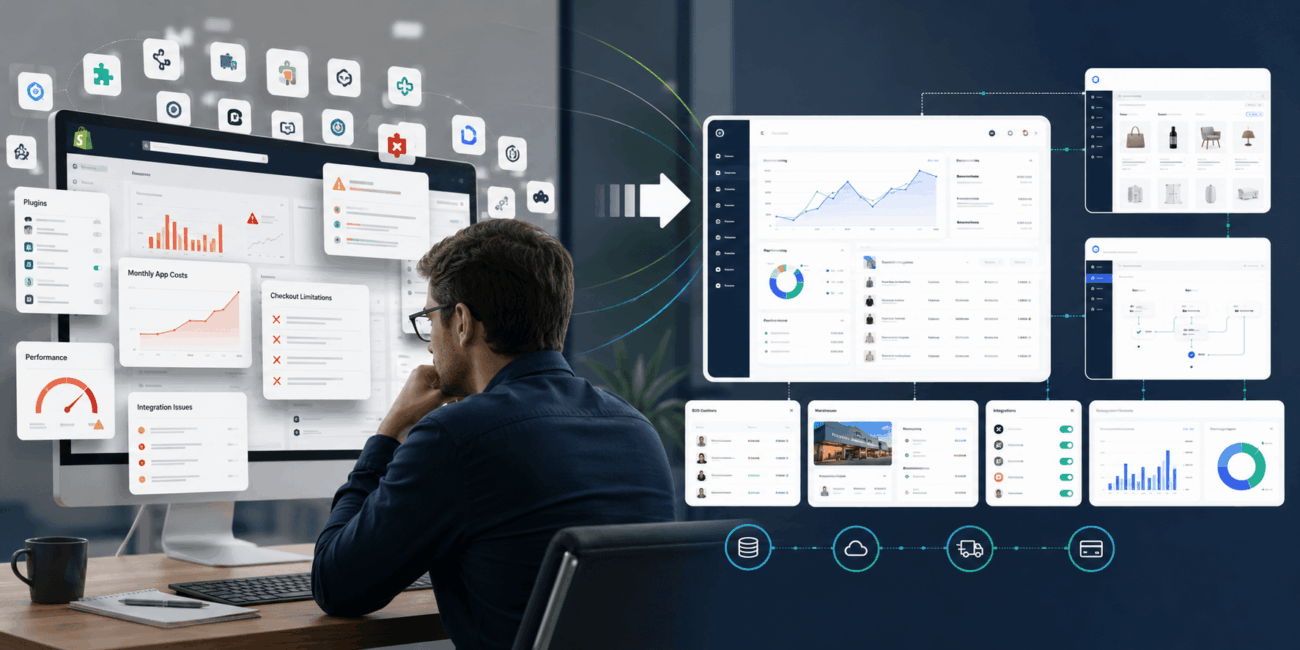
Shopify is genuinely good at what it does.
For a business just starting out, getting products online quickly, processing payments, and managing basic inventory, Shopify is hard to beat. The setup is fast, the interface is friendly, and you can have a working store live in a weekend.
But Shopify was built for a specific type of business at a specific stage of growth. And if your business has moved beyond that stage, you will start feeling it. Not all at once, usually as a slow accumulation of workarounds, rising fees, and moments where you need Shopify to do something it simply was not designed for.
If you have been running on Shopify for a while and something feels like it is not quite working the way it should, this article is worth reading. We are going to walk through the clearest signs that your business has genuinely outgrown Shopify, and what your real options are when that happens.
Sign 1: Your Monthly Shopify Costs Keep Climbing Without a Clear Ceiling
When you started on Shopify, the monthly fee felt reasonable. But as your business has grown, so has the bill.
The base subscription is just the beginning. Add transaction fees on every sale if you are not using Shopify Payments. Add the apps you need for functionality that the platform does not include natively: abandoned cart recovery, advanced reporting, subscription billing, loyalty programs, B2B pricing, and multi-currency display. Each one adds $10, $20, or $50 per month to your total.
It is not unusual for a mid-size Shopify store to be paying $500 to $1,500 per month across subscription, apps, and transaction fees for features that would be built once and owned permanently in a custom ecommerce platform.
If you find yourself regularly calculating how much you are paying Shopify every month and wondering if there is a better way, that is your first sign.
Sign 2: You Are Using Too Many Apps to Fill Gaps the Platform Cannot Handle
There is an app for almost everything on Shopify. And that sounds like a good thing until you are running 15 different apps that were never designed to work together.
Apps slow your store down. They sometimes conflict with each other. When one app updates and breaks something, you spend hours figuring out which one caused the problem. And every app you add is another monthly fee, another support relationship, another point of failure.
More importantly, if your business needs a specific workflow or feature and the only way to get it is through an app built for a different kind of business, you are always working around the platform rather than with it.
A business that needs 10 or more apps to function the way it wants to is a business that has outgrown what the platform was built for.
Sign 3: Your Checkout Flow Cannot Be Customised the Way You Need
Shopify’s checkout is famously locked down, especially on lower-tier plans. You can change colours and add a logo, but the fundamental structure of how a customer moves from cart to payment is controlled by Shopify, not by you.
For standard retail, this is fine. But businesses with more complex needs run into walls quickly:
- B2B or wholesale businesses that need custom pricing by customer group
- Businesses that sell subscription products with flexible billing options
- Stores that need custom fields on the checkout page for delivery instructions, gift messages, or personalisation
- Businesses that need a multi-step checkout tailored to their specific product configuration process
If your customers regularly hit friction points in checkout that you cannot fix because Shopify does not allow it, that is a sign the platform is working against your conversion rate rather than for it.
Sign 4: You Are Selling Wholesale or B2B, and Shopify Is Making It Complicated
Shopify was built primarily for direct-to-consumer retail. Wholesale and B2B ecommerce have very different requirements, and Shopify handles them awkwardly at best.
Wholesale businesses typically need:
- Different pricing tiers for different customer groups
- Minimum order quantities per product or category
- Purchase order and invoice-based payment options rather than immediate card payment
- Credit terms and net payment options for approved accounts
- Custom product visibility, showing certain products only to certain customer groups
- Bulk ordering interfaces that work for buyers purchasing 50 units at a time, not 1
Shopify Plus offers some of this, but at a price point of $2,000 per month that many growing wholesale businesses find hard to justify when a custom-built platform would handle all of it natively for a one-time development cost.
If you are running a wholesale or B2B operation on Shopify and spending significant time managing workarounds for pricing, ordering, and accounts, your platform is not built for your business model.
Sign 5: Your Store Is Slower Than It Should Be
Page speed is directly connected to conversion rate. Research consistently shows that for every one second of additional load time, e-commerce conversion rates drop measurably. For a store doing real revenue, that is not a small problem.
Shopify stores slow down for predictable reasons. Too many apps are each loading their own scripts. A heavily customised theme with code layered on by different developers over time. Large image files that the platform does not always optimise well. Third-party integrations that add HTTP requests on every page load.
You can improve a Shopify store’s speed, but you are always working within the platform’s constraints. You cannot fundamentally change how it loads, how it handles scripts, or how it structures its pages.
A custom-built ecommerce platform gives you complete control over performance from the ground up – no bloated app scripts, no theme framework overhead, no platform constraints on how your pages are served.
Sign 6: You Need Integrations That Shopify Cannot Handle Cleanly
Most growing ecommerce businesses eventually need their store to talk to other systems, such as an ERP, a warehouse management system, a custom CRM, a third-party logistics provider, or an internal tool built specifically for their operations.
Shopify has an API, and there are integration tools available. But connecting Shopify cleanly to complex or custom internal systems is often a messy, fragile process that requires ongoing maintenance every time either system updates.
If your operations team is spending significant time manually moving data between Shopify and other systems, exporting, reformatting, and importing, because the integration does not work reliably, that is a real business cost hiding in plain sight.
A custom ecommerce platform is built with your specific integrations designed in from the start, not bolted on afterwards.
Sign 7: You Cannot Get the Reporting and Data You Actually Need
Shopify’s built-in reporting covers the basics well. But growing businesses often need data that goes beyond what the platform surfaces natively.
Custom cohort analysis, detailed customer lifetime value reporting, product performance broken down by specific attributes, inventory forecasting integrated with sales trends, and margin reporting that accounts for all your actual costs. These things require either expensive Shopify Plus features, third-party reporting apps, or manual work exporting data into spreadsheets.
If your decisions are being made on incomplete data because getting the right information out of Shopify is too difficult or too expensive, your platform is limiting your ability to run your business intelligently.
What Are Your Options When You Have Outgrown Shopify?
If several of the signs above resonate with your situation, you essentially have three paths forward.
Option 1: Upgrade to Shopify Plus
Shopify Plus starts at around $2,000 per month and removes some of the platform’s most frustrating limitations, more checkout customisation, better wholesale features, dedicated support, and higher API limits.
This makes sense if your issues are primarily about platform limits rather than fundamental architectural constraints, and if your monthly revenue comfortably justifies the cost increase.
It does not solve the fundamental issue that you are still paying ongoing fees indefinitely, still dependent on apps for many features, and still working within Shopify’s architecture rather than owning your platform outright.
Option 2: Move to WooCommerce
WooCommerce gives you more flexibility than standard Shopify and eliminates transaction fees. It runs on WordPress, which many businesses already use and understand.
However, WooCommerce has its own limitations for complex e-commerce requirements. At scale, it requires significant hosting investment, performance optimisation, and ongoing maintenance. And you are still working within a plugin-based system where complex requirements often lead to the same app-dependency problems you had on Shopify.
Read our detailed comparison of Shopify vs custom e-commerce to understand where each platform fits and where both fall short.
Option 3: Move to a Custom E-commerce Platform
A custom ecommerce development solution means building a platform from the ground up, designed specifically around your business logic, your workflows, and your customers.
This is not the right choice for every business. It requires a higher upfront investment and a longer initial build time. But for businesses that have genuinely hit the ceiling of what Shopify can do, it removes every limitation in one decision.
With a custom platform you own:
- Every line of code, no ongoing platform fees
- Every feature is built exactly the way your business needs it
- The checkout flow, pricing logic, and customer experience without platform restrictions
- Clean integrations with your existing systems are designed from the start
- Performance optimised for your specific product catalogue and traffic patterns
- Reporting built around the data points that actually matter to your business
The ongoing cost of Shopify subscription, apps, and transaction fees often means a custom platform pays for itself within 18 to 24 months for a business doing consistent revenue.
How Much Does Moving to a Custom Ecommerce Platform Cost?
This is the question most business owners ask first, and it is the right question.
The honest answer is that it depends on what your business needs. A custom e-commerce platform for a business with straightforward requirements is a very different project from one built for complex B2B wholesale with multiple integrations.
As a general guide:
| Project Scope | Starting From |
|---|---|
| Custom e-commerce – standard retail | $1,999 |
| Custom e-commerce with an admin panel and custom features | $3,999 |
| B2B / wholesale platform with complex pricing logic | $6,999+ |
| Full platform migration from Shopify with data transfer | Custom quote |
All projects are quoted in USD with a fixed price agreed before any work begins. No hourly billing surprises.
How Web Logic Labs Handles Shopify Migrations
At Web Logic Labs, we specialise in custom e-commerce development and have worked with businesses across the US, UK, Canada, Australia, and global clients who have made exactly this decision.
When a business moves from Shopify to a custom platform with us, here is what happens:
We start by understanding your business fully, not just the technical requirements, but how your team actually works, what your customers expect, and where Shopify has been letting you down specifically.
We migrate your existing data, products, customer records, order history, and any other data that needs to move from Shopify to your new platform without loss.
We build the features Shopify could not give you: the checkout flow you actually need, the pricing logic your customers expect, the integrations your operations require.
We make sure your SEO transfers correctly URL redirects, metadata, and sitemap updates so your search rankings are protected through the migration.
We train your team on the new platform your staff need to be confident managing the new system from day one. We provide documentation and a handover session before going live.
We stay available after launch migrations, always surface edge cases after go-live. We are available for support and fixes in the weeks following launch.
Is a Custom Ecommerce Platform Right for Your Business?
Not every business on Shopify should move to a custom platform. If you are an early-stage, growing steadily, and Shopify is working well enough, stay on it and focus on your business.
But if you recognise several of the signs in this article, rising costs, checkout limitations, B2B complexity, integration problems, speed issues, and your monthly Shopify spend is already significant, the conversation about a custom platform is worth having.
Contact Web Logic Labs with a brief description of your current situation and what Shopify is not doing for you. We will give you an honest assessment of whether a custom platform makes sense for your business and if it does, what it would cost and how long it would take.
No obligation. Just a straight conversation.
Frequently Asked Questions
Will I lose my SEO rankings when I migrate away from Shopify?
Not if the migration is handled correctly. The key is setting up proper 301 redirects from every old Shopify URL to the equivalent new URL, transferring all metadata, and submitting an updated sitemap to Google immediately after launch. We handle all of this as part of every migration project.
Can you migrate all my products and customer data from Shopify?
Yes. Shopify allows full data export, and we handle the import into your new custom platform products, variants, customer records, and order history.
How long does a Shopify migration take?
A standard migration with a custom e-commerce build typically runs 6 to 10 weeks, depending on the complexity of your product catalogue and the features required. We give a specific timeline after reviewing your requirements.
Do I need to keep paying Shopify fees during the build?
Yes, you keep your Shopify store running normally while we build the new platform in parallel. You only switch over when the new platform is fully tested and ready to go live.
What technology do you build custom e-commerce platforms on?
We build primarily in PHP and Laravel for custom e-commerce platforms, with React and Node.js for more complex application requirements. All platforms are built on your own hosting; you own the code and the infrastructure outright.
Ready to Explore Your Options?
If Shopify is holding your business back, let us have an honest conversation about what a custom platform would look like for you.
Contact Web Logic Labs today, describe your current situation, and we will respond within 24 hours with a clear assessment and next steps.
Web Logic Labs provides custom e-commerce development and Shopify migration services for businesses across the US, UK, Canada, Australia, and global clients. Building custom e-commerce solutions since 2009.
