
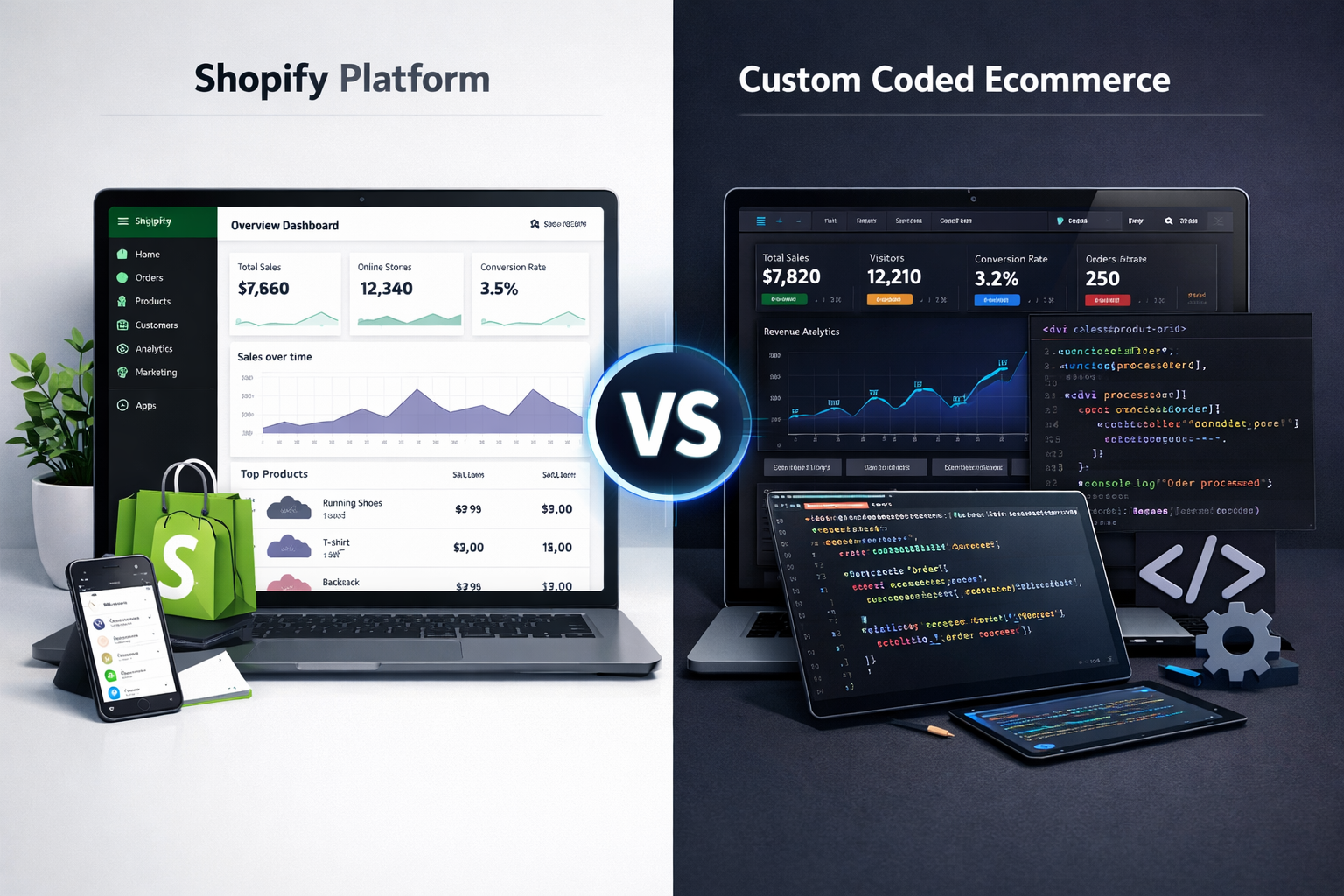
Starting an online store is easier today than ever before. However, choosing the right e-commerce platform is one of the most important decisions for your business.
Two of the most common options are Shopify and custom e-commerce development.
Both solutions allow businesses to sell products online. However, they differ significantly in terms of flexibility, scalability, cost, and long-term control.
Therefore, understanding the difference between Shopify and custom e-commerce development can help you make the right decision for your business growth.
In this guide, we will compare both options so you can determine which one fits your business goals best.
What is Shopify?
Shopify is a hosted e-commerce platform that allows businesses to create and manage online stores quickly without needing deep technical knowledge.
In other words, Shopify provides everything required to run an e-commerce store, including:
- Hosting
- Security
- Payment integration
- Themes and design templates
- App marketplace
Because of its simplicity, Shopify is often preferred by small businesses and entrepreneurs who want to launch their online store quickly.
Moreover, Shopify manages most technical aspects such as updates, hosting, and server maintenance.
What is Custom E-commerce Development?
Custom ecommerce development means building an online store from scratch, based entirely on your business requirements.
Unlike Shopify, a custom e-commerce website is designed specifically for your workflow, products, integrations, and user experience.
For example, a custom ecommerce platform may include:
- Custom product management systems
- Unique checkout processes
- ERP or CRM integrations
- Advanced pricing models
- Subscription systems
As a result, businesses get complete flexibility and control over their e-commerce platform.
Technologies commonly used for custom e-commerce development include:
- Laravel
- Core PHP
- MERN Stack
- Custom API integrations
Shopify vs Custom E-Commerce: Key Differences
| Feature | Shopify | Custom Ecommerce Development |
|---|---|---|
| Setup Time | Very fast | Moderate to long |
| Flexibility | Limited | Fully customizable |
| Hosting | Included | Requires hosting |
| Cost | Monthly subscription | One-time development cost |
| Scalability | Limited for complex features | Highly scalable |
| Custom Features | Limited | Unlimited |
| Ownership | Platform dependent | Full ownership |
Overall, Shopify is ideal for quick store launches, while custom ecommerce solutions are better for complex business models.
When Should You Choose Shopify?
Shopify is a great option if you want to launch an e-commerce store quickly with minimal technical effort.
For example, Shopify is suitable for:
- Small product catalogs
- Dropshipping businesses
- Startups testing product ideas
- Businesses without technical teams
Furthermore, Shopify provides a large marketplace of apps that can extend functionality.
However, as your business grows, you may start facing limitations in customization and scalability.
When Should You Choose Custom E-commerce Development?
Custom e-commerce development becomes the better choice when your business requires advanced features or unique workflows.
For example, custom e-commerce is ideal for:
- Large product catalogs
- Complex pricing systems
- B2B ecommerce platforms
- Multi-vendor marketplaces
- Subscription-based businesses
Moreover, custom solutions allow businesses to create unique user experiences that are difficult to achieve using standard e-commerce platforms.
Therefore, companies planning long-term growth often prefer custom e-commerce development.
Cost Comparison: Shopify vs Custom E-commerce
Cost is another important factor when choosing an e-commerce solution.
Shopify Costs
Typical Shopify expenses include:
- Monthly subscription
- Premium themes
- Paid apps
- Transaction fees
Although the initial setup cost is lower, these recurring expenses can increase over time.
Custom Ecommerce Costs
Custom ecommerce websites usually involve:
- One-time development cost
- Hosting and server expenses
- Maintenance and updates
However, businesses benefit from full ownership and flexibility.
In the long run, custom e-commerce development can provide better ROI for growing businesses.
Which E-commerce Solution Is Best for Your Business?
The right choice ultimately depends on your business goals, technical requirements, and growth plans.
Choose Shopify if you:
- Want a quick store launch
- Prefer a managed platform
- Have a small to medium-sized catalog
Choose custom e-commerce development if you:
- Need unique features
- Plan to scale significantly
- Require system integrations
- Want full control over your platform
Therefore, evaluating both short-term convenience and long-term scalability is essential before making a decision.
E-commerce Development Services at WebLogicLabs
At WebLogicLabs, we help businesses choose and implement the right e-commerce solution based on their goals.
Our e-commerce development services include:
- Shopify store development
- Shopify theme customization
- Custom e-commerce development
- Payment gateway integration
- Performance optimization
- E-commerce website migration
Most importantly, we focus on building scalable ecommerce platforms that support long-term business growth.
Conclusion
Both Shopify and custom e-commerce development have their advantages.
Shopify is ideal for businesses looking for speed and simplicity, while custom ecommerce platforms provide flexibility and scalability for long-term growth.
Therefore, the best solution depends on your business model, product catalog, and expansion plans.
If you are unsure which platform is right for your business, consulting an experienced e-commerce development partner can help you make the right decision.
Let’s Build Your E-commerce Store
Planning to launch or upgrade your e-commerce store?
At WebLogicLabs, we help businesses build high-performing ecommerce platforms using Shopify or custom development solutions.
📩 Contact us today for a free consultation and discover the best e-commerce solution for your business.
